Why Next.js is Better Than React.js? A Complete Guide

Introduction
If you're starting your web development journey, you've probably asked yourself:
Should I learn React.js or Next.js?
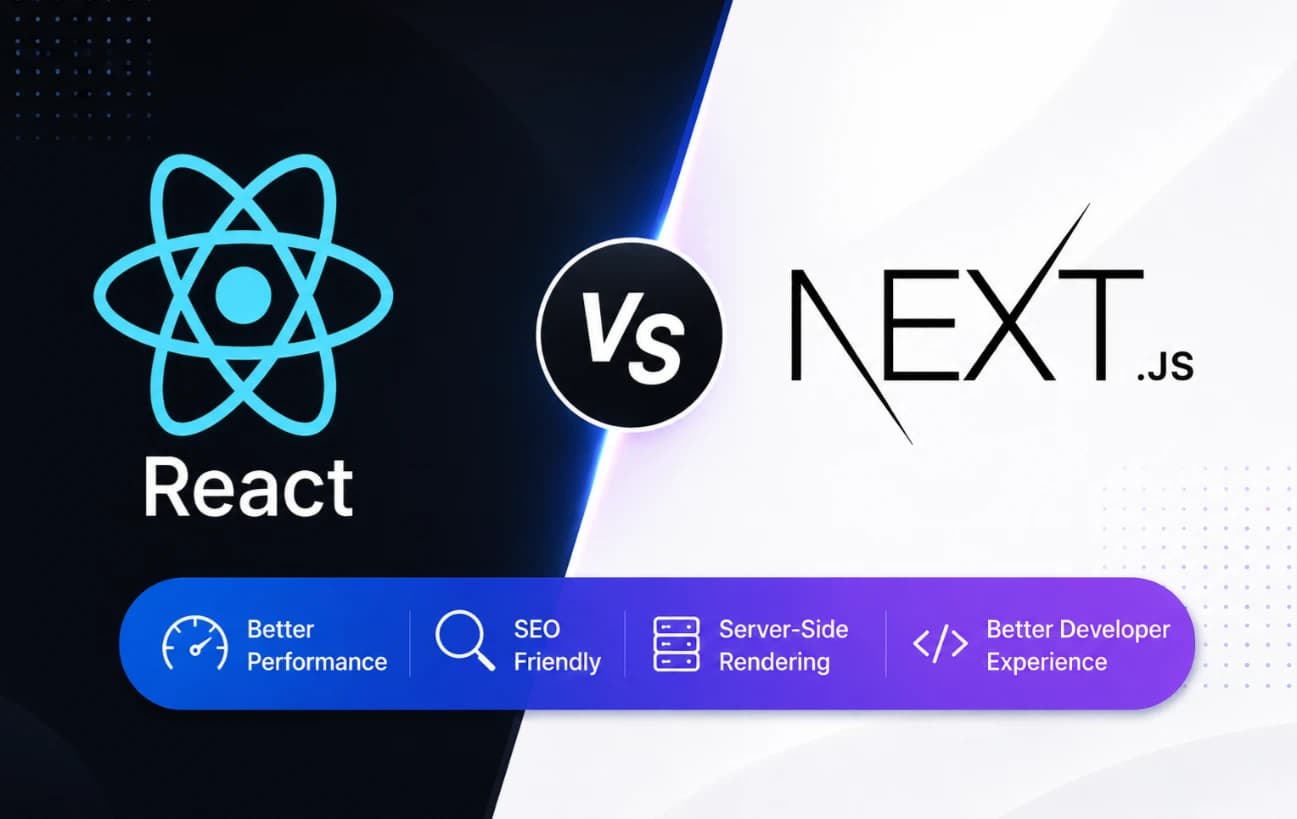
It's one of the most common questions among beginners.Many developers think React and Next.js are competitors. They are not. React is a JavaScript library. Next.js is a framework built on top of React.
That means whenever you build a Next.js application, you're still using React—but with many extra features that make development faster, easier, and more powerful. In this article, we'll compare React.js and Next.js in simple language so you can understand which one is the better choice for modern web development.
What is React?
React is a JavaScript library created by Meta for building user interfaces.
Its main job is to help developers build reusable UI components.
For example:
Navbar
Button
Card
Dashboard
Modal
Sidebar
React only focuses on the UI.
If you need routing, SEO, authentication, or server-side rendering, you'll have to add those yourself using additional libraries.
What is Next.js?
Next.js is a React framework developed by Vercel.
It includes everything React provides, plus many powerful features out of the box.
With Next.js, you get:
File-based routing
Server-Side Rendering (SSR)
Static Site Generation (SSG)
App Router
Image Optimization
SEO support
API Routes
Middleware
Better performance
Instead of installing multiple libraries, many essential features are already built into the framework.
React vs Next.js
Feature | React.js | Next.js |
|---|---|---|
Routing | ❌ External library | ✅ Built-in |
SEO | ❌ Difficult | ✅ Excellent |
Performance | ⭐ Good | ⭐⭐⭐ Excellent |
Image Optimization | ❌ Manual | ✅ Built-in |
Server Rendering | ❌ No | ✅ Yes |
Static Generation | ❌ No | ✅ Yes |
API Routes | ❌ No | ✅ Yes |
Middleware | ❌ No | ✅ Yes |
Deployment | Manual | Easy |
From this comparison, it's clear that Next.js offers a more complete development experience.
Why Next.js is Better
1. Better SEO
One of the biggest reasons developers choose Next.js is SEO.
React applications usually render content in the browser after JavaScript loads.
Search engines may have a harder time indexing these pages, especially if they're not rendered efficiently.
Next.js can render pages on the server before sending them to the browser, making content available immediately.
This improves visibility on search engines.
If you're building:
Business websites
Blogs
Portfolio sites
SaaS landing pages
E-commerce websites
Next.js is often a better choice because SEO matters.
2. Faster Performance
Performance directly affects user experience.
Next.js includes several built-in optimizations, such as:
Automatic code splitting
Lazy loading
Image optimization
Font optimization
Smart caching
These features help your website load faster without requiring extra configuration.
3. Built-in Routing
In React, you typically install an additional library like React Router to handle navigation.
In Next.js, routing is based on your folder structure.
Create a file like:
app/about/page.tsxand your page automatically becomes:
/aboutIt's simple, clean, and easy to maintain.
4. Server Components
Next.js introduces React Server Components.
This means some components run on the server instead of the browser.
Benefits include:
Smaller JavaScript bundles
Faster loading
Better security
Improved performance
This is one of the biggest improvements in modern React development.
5. Image Optimization
Images often slow down websites.
Next.js solves this with the next/image component.
It automatically:
Optimizes images
Serves modern formats
Lazy loads images
Generates responsive sizes
This improves both speed and Core Web Vitals.
6. Better Developer Experience
Next.js makes development smoother by including features such as:
TypeScript support
Fast Refresh
App Router
Middleware
API Routes
Built-in Metadata API
Instead of spending time configuring tools, you can focus on building your application.
When Should You Use React?
React is still a great choice for certain projects.
Use React when you're building:
Internal dashboards
Admin panels
Small applications
Embedded widgets
Existing React projects
These projects may not require advanced SEO or server-side rendering.
When Should You Use Next.js?
Next.js is a strong choice for:
Business websites
Company websites
SaaS products
Blogs
Portfolios
E-commerce stores
Marketing landing pages
Web applications
If SEO, speed, and scalability are important, Next.js is usually the better option.
My Recommendation
If you're learning web development today, start with React fundamentals so you understand components, state, props, and hooks.
Once you're comfortable with React, move to Next.js for building real-world applications.
That's the path many professional developers follow because Next.js builds on top of React rather than replacing it.
Final Thoughts
React changed the way we build user interfaces, and Next.js has taken that foundation further by solving many of the challenges developers face in production.
For most modern websites and web applications, Next.js provides better performance, stronger SEO, and a more complete development experience with less setup.
If you're starting a new project today, Next.js is a practical choice for building fast, scalable, and search-engine-friendly applications.